The Hague, May 16-17, 2026
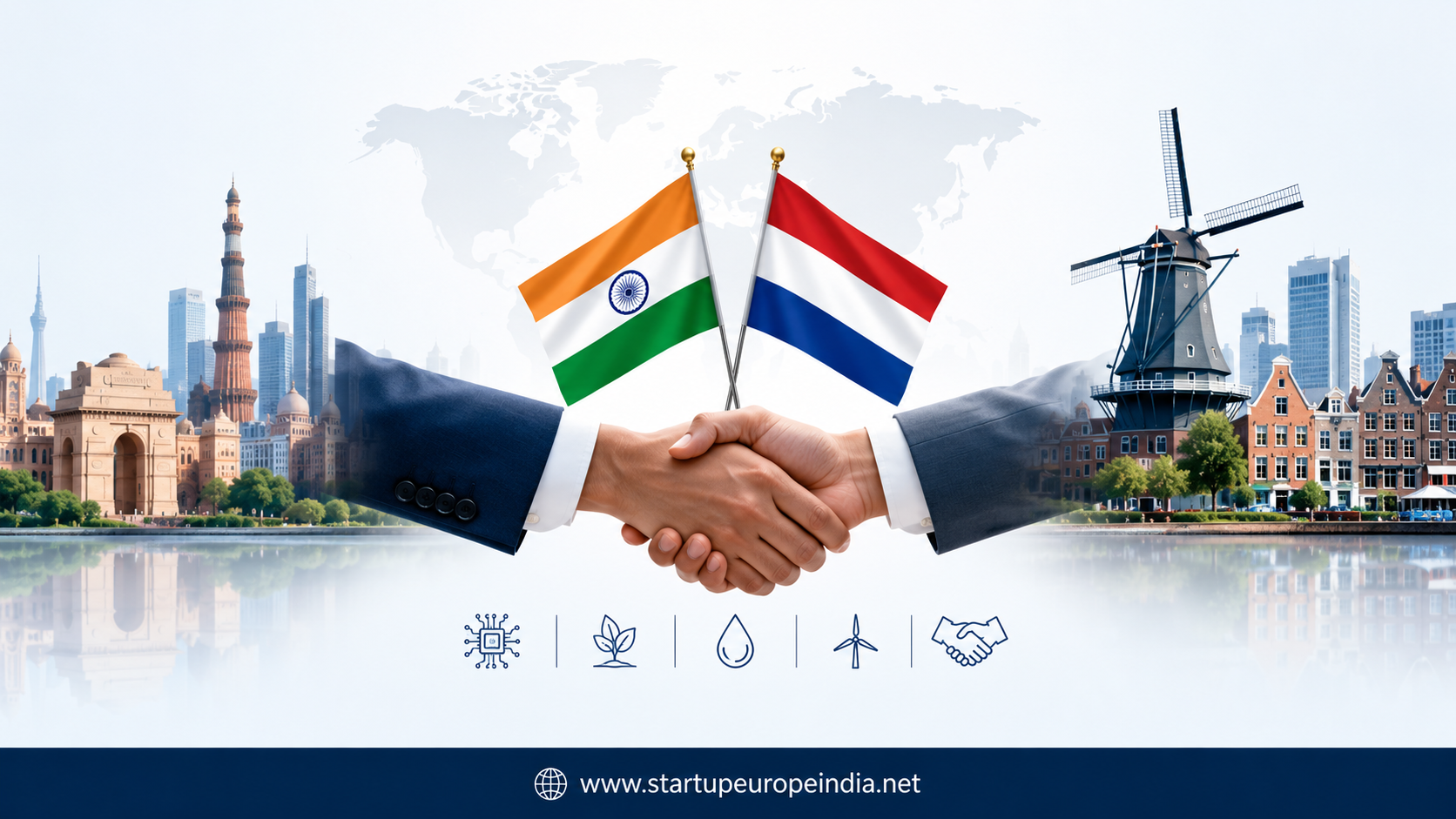
Prime Minister Narendra Modi visited the Netherlands on May 16-17, 2026, as the second stop on a five-nation tour covering the UAE, Netherlands, Sweden, Norway, and Italy (May 15-20). It was his second visit to the country.
Rob Jetten has been Prime Minister of the Netherlands since February 23, 2026, when he succeeded Dick Schoof after his centrist Democrats 66 party won snap elections in October 2025. Jetten is the Netherlands' youngest-ever Prime Minister.
On the morning of May 16, Modi was received by King Willem-Alexander and Queen Maxima at the Royal Palace Huis ten Bosch in The Hague for a bilateral meeting and luncheon. Modi and Jetten then held restricted and delegation-level talks, followed by dinner. On May 17, both Prime Ministers visited the Afsluitdijk, a 32-kilometre dam on the North Sea coast that protects large parts of the Netherlands from flooding while enabling freshwater storage, with a direct comparison drawn to India's proposed Kalpasar Project in Gujarat.
Ahead of the formal talks, Modi and Jetten met jointly with chief executives of major Dutch companies operating across energy, ports, agriculture, healthcare, trade, and technology. Modi invited Dutch firms to explore investment opportunities in India in maritime infrastructure, renewable energy, semiconductors, digital technologies, AI, and healthcare.
The visit produced 17 signed agreements and the adoption of the India-Netherlands Strategic Partnership Roadmap 2026-2030, the first time the two countries have elevated their bilateral relationship to the level of a formal Strategic Partnership.
THE ECONOMIC BASELINE
Bilateral trade between India and the Netherlands reached $27.8 billion in 2024-25. The Netherlands is India's fourth-largest foreign investor with cumulative FDI of $55.6 billion. The Netherlands also serves as a primary logistics gateway into Europe for Indian exporters through the Port of Rotterdam.
Both leaders underlined the importance of the India-EU Free Trade Agreement, whose negotiations concluded in January 2026, as a mechanism to deepen economic ties between the world's second and fourth-largest economies. The India-EU Security and Defence partnership was also simultaneously signed, covering maritime security, cyber, counterterrorism, and defence industrial collaboration.
TECHNOLOGY: THE CORE OF THE PARTNERSHIP
The technology agenda was the most substantive part of the visit and deserves more detail than most coverage provided.
SEMICONDUCTORS AND EMERGING TECHNOLOGIES MoU
A Memorandum of Understanding on a Partnership on Semiconductors and Related Emerging Technologies was signed, providing the legal and policy framework for all semiconductor cooperation flowing from the visit.
The scope of the MoU goes beyond chip manufacturing. Building on this agreement, India and the Netherlands committed to jointly explore cooperation in artificial intelligence, photonics, quantum technologies, and cybersecurity, and to forge technology value-chain partnerships in both countries across these sectors. This is a significant addition to what would otherwise read as a chips-only deal. Photonics and quantum are not incidental references; they reflect the actual industrial strengths of the Dutch technology ecosystem, particularly through companies like ASML (lithography and optics), NXP Semiconductors (automotive and IoT chips), and the broader Eindhoven technology corridor.
TATA ELECTRONICS AND ASML
The operational centerpiece of the semiconductor MoU is the deal between Tata Electronics and ASML, signed in the presence of both Prime Ministers.
ASML will supply DUV (Deep Ultraviolet) lithography tools, workforce training, and supply chain support for Tata's Dholera 300mm semiconductor fab in Gujarat. Process technology for the fab comes from Taiwan's Powerchip Semiconductor Manufacturing Corporation, covering nodes at 28nm, 40nm, 55nm, 90nm, and 110nm. At full capacity, the fab will produce 50,000 wafers per month, manufacturing power management ICs, display drivers, microcontrollers, and high-performance computing logic for automotive, mobile, AI, and communications markets.
The Dholera site was formally designated a Special Economic Zone in April 2026. Initial commercial production is scheduled for late 2026, with ASML tools being installed and calibrated through 2026. Total investment in the Dholera project is approximately $11 billion. Tata has already sent over 200 personnel to PSMC's Taiwan facilities for training.
ASML's most advanced EUV systems, used for sub-10nm production, are not in scope for this phase. The deal uses DUV tools appropriate for the 28nm to 110nm node range. This is the correct tool category for mature nodes and does not represent a gap in the agreement; it reflects what the production roadmap requires.
DUTCH SEMICON COMPETENCE CENTRE AND INDIAN SEMICONDUCTOR MISSION
India and the Netherlands agreed to formally connect the Dutch Semicon Competence Centre to the Indian Semiconductor Mission (ISM). The purpose is to extend Dutch semiconductor ecosystem support to Indian industries, startups, scale-ups, SMEs, and their suppliers through collaboration, technology transfer, and talent development. The Indo-Dutch Semicon Online School, which has been running bilaterally, will continue into its next phase.
SEMICONDUCTOR BRAIN BRIDGE: THE ACADEMIC-INDUSTRY CONSORTIUM
A Memorandum of Cooperation was adopted between two Dutch technical universities, Eindhoven University of Technology and the University of Twente, and six Indian institutions: IISc Bangalore, IIT Bombay, IIT Delhi, IIT Gandhinagar, IIT Guwahati, and IIT Madras. The initiative is backed by four companies: NXP Semiconductors, ASML, Tata Electronics, and CG Semi.
The stated purpose is a "brain bridge" in semiconductors and related technologies, combining academic R&D with direct industry participation from both sides. This is notable because it addresses the talent pipeline problem directly, rather than leaving it as a future aspiration. Eindhoven University of Technology sits in the heart of the Dutch semiconductor corridor and has deep existing ties with ASML and NXP; IISc and the named IITs are India's strongest technical research institutions.
SCIENCE, TECHNOLOGY AND INNOVATION: JOINT WORKING GROUP
Both sides agreed to intensify collaboration through the existing Joint Working Group on Science, Technology and Innovation, specifically aligning national research priorities in energy materials, biomolecular and cell technologies, AI, and cybersecurity. The roadmap references almost fifty large joint research and innovation programs launched in prior years as the foundation for this next phase.
SPACE COOPERATION
The roadmap explicitly includes space-based applications as a cooperation area, focused on using satellite data to address societal challenges including climate change, water management, food security, and air quality. This is a continuation of existing bilateral cooperation in the space sector rather than a new standalone agreement, but its inclusion in the five-year roadmap gives it a structured implementation frame.
CRITICAL MINERALS
A Memorandum of Understanding on Critical Minerals was signed, covering the full value chain: exploration, research and innovation, supply chain integration, ESG standards, and circularity. The context matters here. China controls the extraction and refining of over 15 critical minerals globally. The India-Netherlands partnership on critical minerals feeds directly into semiconductor supply chain resilience, since rare earths and specialty materials are inputs into chip manufacturing. This agreement should be read alongside the semiconductor MoU, not separately.
GREEN HYDROGEN AND ENERGY TRANSITION
The India-Netherlands Roadmap on the Development of Green Hydrogen was launched. This is a bilateral roadmap document, not just a policy statement. It covers production, usage, and export of green hydrogen, and includes the development of a green corridor between India and the Netherlands, which is the trade infrastructure for India to export green hydrogen to European markets.
A Joint Working Group on Renewable Energy was established under the existing bilateral MoU on Renewable Energy, covering solar, green hydrogen, storage, and investment in the sector.
The renewal of the Joint Statement of Intent on Capacity Building for Energy Transition between NITI Aayog and the Netherlands was confirmed.
The Netherlands formally joined the Global Biofuels Alliance, which India launched during its G20 Presidency in 2023.
In sustainable mobility, both sides agreed to cooperate on smart charging infrastructure, battery technology and system integration, standardisation, heavy and medium-heavy zero-emission vehicles, smart urban mobility systems, and alternative fuels.
DEFENCE AND SECURITY
A Letter of Intent on Defence Cooperation was signed, covering structured joint tri-services interaction between the Directorates of International Military Cooperation of both countries, coordinating bilateral military engagement including between defence industries and research centres. Both sides agreed to explore a Defence Industrial Roadmap covering co-development, technology transfer, and joint ventures for co-production of defence equipment, systems, and components.
A Letter of Intent on Cyberspace Collaboration was signed, covering closer coordination in multilateral forums and joint efforts on countering cyber threats and cybercrime through capacity building and knowledge exchange. The 8th session of the Indo-Dutch online cyber school was noted as an ongoing mechanism under this framework.
On counterterrorism, Jetten explicitly condemned the April 2025 Pahalgam attack in which 26 people were killed, extended the Netherlands' solidarity with India in its fight against cross-border terrorism, and supported India's push for a UN Comprehensive Convention on International Terrorism. Both sides called for concerted action against groups proscribed under UN Security Council 1267 Sanctions Committee designations.
WATER MANAGEMENT
A Centre of Excellence on Water was established at IIT Delhi under the Ministry of Jal Shakti, in collaboration with the Netherlands' Ministry of Infrastructure and Water Management. Both leaders agreed to deepen cooperation on the Kalpasar Project in Gujarat, where Dutch technical and engineering expertise will be deployed. The Afsluitdijk visit on May 17 was framed around this parallel explicitly.
Joint programs under the Strategic Partnership on Water are already active in Uttar Pradesh, Maharashtra, West Bengal, Tamil Nadu, and Kerala, including within the Namami Gange Mission.
MARITIME
A renewed Memorandum of Understanding on Maritime Cooperation was noted. Both sides agreed to work toward a Strategic Roadmap on a Green and Digital Sea Corridor between India and the Netherlands, building on a Letter of Intent signed in October 2025. The corridor is intended to be environmentally sustainable, digitally integrated, and economically efficient. This maritime corridor is also the physical infrastructure through which India's green hydrogen exports to Europe would eventually flow.
The Netherlands also announced its decision to join India's Indo-Pacific Oceans Initiative (IPOI) and co-lead the Capacity Building and Resource Sharing pillar with Germany and the European Union.
HIGHER EDUCATION
A Memorandum of Understanding on Higher Education was signed between India's Ministry of Education and the Netherlands' Ministry of Education, Culture and Science.
A Memorandum of Understanding was signed between the University of Groningen and 19 Indian Institutes of Technology.
A PhD Fellowship Programme on Hydrogen was established between India's Department of Science and Technology and the University of Groningen, directly connecting academic research to the green hydrogen agenda.
HEALTH
The Memorandum of Understanding on Healthcare and Public Health was renewed. A Letter of Intent was signed between the Dutch National Institute for Public Health (RIVM) and the Indian Council of Medical Research (ICMR), covering infectious diseases, vector-borne diseases, One Health, and disease surveillance. Enhanced cooperation in pharmaceuticals and medical devices was confirmed under a MoU signed in June 2025, with the first Joint Working Group meeting to be held in 2026.
AGRICULTURE AND FOOD SAFETY
A Joint Declaration was signed between India's Ministry of Fisheries, Animal Husbandry and Dairying and the Netherlands' Ministry of Agriculture, Fisheries, Food Security and Nature. An Indo-Dutch Centre of Excellence on Training in Dairy was established at the Centre of Excellence for Animal Husbandry in Bengaluru. A Memorandum of Understanding was signed between Naktuinbouw and India's National Horticulture Board for India's Clean Plant Programme. A Memorandum of Understanding was signed between the Netherlands Food and Consumer Product Safety Authority (NVWA) and India's Food Safety and Standards Authority of India (FSSAI).
TRADE AND CUSTOMS
An Agreement on Mutual Administrative Assistance in Customs Matters was signed, enabling information exchange between customs authorities to strengthen enforcement and facilitate trade. The India-Netherlands Joint Trade and Investment Committee (JTIC) and bilateral Fast Track Mechanism for investments were confirmed as ongoing coordination tools.
MIGRATION AND MOBILITY
A Memorandum of Understanding on Migration and Mobility was signed, covering fair movement of highly skilled professionals, transparent visa processes, prevention of irregular migration, and anti-trafficking cooperation.
CULTURE
A Memorandum of Understanding was signed between the National Maritime Museum of Amsterdam and India's Ministry of Ports, Shipping and Waterways for cooperation in developing the National Maritime Heritage Complex in Lothal, Gujarat. The Chola Era Copper Plates, 11th-century artifacts held at Leiden University, were formally repatriated to India during a ceremony on May 16.
GOVERNANCE OF THE PARTNERSHIP
The Strategic Partnership Roadmap 2026-2030 establishes a Foreign Ministers' mechanism that will hold annual meetings to review progress across all 17 agreements and give strategic direction. This accountability structure, combined with the existing JTIC and Fast Track Mechanism for investments, means there are at least three institutional review layers built into the framework. Roadmaps without review mechanisms tend to become shelf documents; the annual Foreign Ministers' layer is the critical difference here.
WHAT WAS MISSING FROM MOST COVERAGE
Most reporting focused on ASML and the semiconductor deal. Three things that received insufficient attention:
First, the photonics and quantum expansion in the semiconductor MoU. The agreement is not limited to chip manufacturing. AI, photonics, quantum technologies, and cybersecurity are explicitly named as cooperation sectors under the same MoU. NXP Semiconductors, which is a significant Dutch company with deep automotive and IoT chip expertise, is part of the academic consortium but received almost no coverage.
Second, the Critical Minerals MoU is directly connected to semiconductor supply chain resilience and to the green hydrogen agenda, since electrolysers and fuel cells also depend on specialty materials. Treating it as a standalone trade deal misses the systems logic.
Third, the Green and Digital Sea Corridor is both a maritime cooperation project and the physical infrastructure that makes India's green hydrogen export ambitions to Europe operationally credible. The hydrogen roadmap and the maritime corridor are the same initiative viewed from two angles.
Join Startup Eirope India Netowork - Scaling innovation and talent, advisors, and partners across Europe, the UK, and India www.startupeuropeindia.net
_<->1708724263995_9Y10OskXA8FdggLg.jpeg?w=3840&q=75)