Tue, Feb 3, 2026

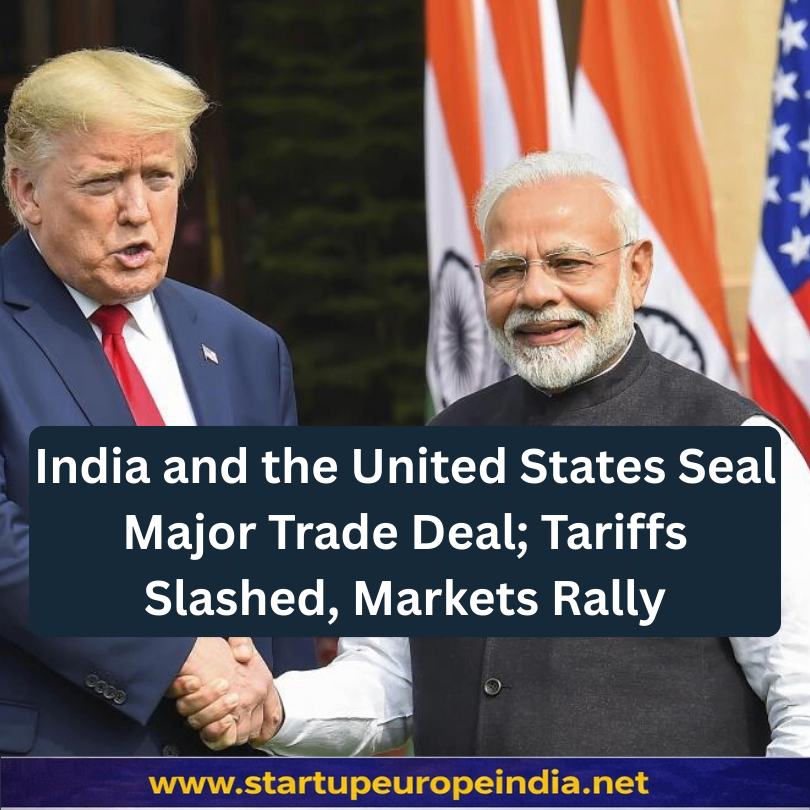
India and the United States Seal Major Trade Deal; Tariffs Slashed, Markets Rally

USA
India
Deep Tech
USA-India
Europe
Sarah   J

Sarah J

Posted on Tue, Feb 3, 2026

4 min read

Share the article with your network

x
Facebook
linkedin

In a significant development on February 3, 2026, India and the United States announced a major bilateral trade agreement aimed at resetting trade relations that had been strained over the past year.

The announcement came after a telephone conversation between Prime Minister Narendra Modi and U.S. President Donald Trump, with both leaders describing the pact as a breakthrough in economic cooperation and an important step toward strengthening ties between the world’s two largest democracies.


At the heart of the agreement is a sharp reduction in reciprocal tariffs on Indian goods entering the U.S. market. Washington has agreed to cut tariffs from previous levels- which reached an effective 50 % after punitive levies linked to India’s purchase of Russian crude -down to around 18 % for a broad basket of Indian products.

This move is expected to improve cost competitiveness for Indian exporters and restore price parity with competitors such as Thailand, Indonesia and Bangladesh.


In return, India is set to reduce or eliminate tariffs and non-tariff barriers on certain U.S. goods, with multiple reports indicating a move toward zero duty on several categories, opening Indian markets to U.S agricultural products, technology, energy and manufactured items.

The deal also involves broader commitments on energy sourcing, with India signalling a reduction in Russian oil purchases and increased imports from the U.S. and other partners.


The agreement effectively reverses the sharp tariff escalation of August 2025, when Washington imposed punitive levies that had significantly raised export costs for Indian goods and triggered market uncertainty. Sectors such as textiles, engineering goods, auto components, gems and jewellery and leather among others had seen order volumes decline due to heightened duties. Experts believe the tariff reset will provide relief to these industries and support a rebound in export volumes in 2026.


Market and Economic Impact

The trade announcement triggered an immediate positive response in Indian financial markets. The rupee strengthened sharply, marking its largest single-day gain in over seven years against the U.S. dollar, while benchmark indices surged, with the Nifty 50 and BSE Sensex both posting strong gains. Investor confidence was boosted by the removal of trade uncertainty after months of tariff volatility.

Trade bodies and industry associations welcomed the reset. The Engineering Export Promotion Council (EEPC India) highlighted that lower tariffs will enhance competitiveness, especially in engineering export segments. Exporters of rice and other agricultural commodities also expressed optimism about improved market access and shipment prospects under the new tariff framework.


Government Reactions and Commentary

Senior Indian leaders framed the agreement as a historic achievement. Commerce Minister Piyush Goyal described the pact as a “landmark trade agreement” between two fair-trading democracies expected to benefit farmers, MSMEs, entrepreneurs, skilled workers and exporters across sectors. External Affairs Minister S Jaishankar noted that the deal will stimulate jobs, growth and innovation, reinforcing India’s “Make in India for the world” agenda.


Finance Minister Nirmala Sitharaman also welcomed the tariff cut as “good news for #MadeInIndia products,” thanking both strategic partners for the development. Leaders across India’s political spectrum, including state officials, highlighted the potential economic gains, though some opposition voices have sought greater transparency on the terms and long-term implications of the pact.


Key Features of the Trade Deal

  • Reduced U.S. tariffs: Indian exports to the U.S. now face an 18 % tariff rate, down from previous levels that included punitive levies.
  • Improved market access: India is expected to reduce tariffs and non-tariff barriers on several U.S. goods, including agriculture and energy products, enhancing bilateral trade flows.
  • Energy and sourcing commitments: India has signalled a shift away from heavy reliance on Russian oil, pledging increased purchases from the U.S. and other suppliers.
  • Broader cooperation: The agreement lays the groundwork for deeper economic engagement across sectors such as technology, defence, agriculture and services, and may serve as a precursor to a more comprehensive future trade pact.


The India-U.S. trade deal of February 2026 represents one of the most consequential developments in bilateral economic relations in recent years recalibrating tariff structures, restoring investor confidence and charting a path for stronger long-term cooperation between two of the world’s fastest-growing major economies.


Join SEINET — the digital partnership ecosystem for tech businesses and leaders in EU-UK and India.

Start with a verified community, and unlock access to the exclusive Leaders Network for qualified founders and decision-makers. Build trusted partnerships and collaborate efficiently across markets www.startupeuropeindia.net


You may also like

Sarah   J

Sarah J

Sat, Jan 31, 2026

India-EU Trade Pact Opens $572 Billion Pharmaceuticals and MedTech Market, Boosting Exports and Competitiveness

The recently concluded India-European Union Free Trade Agreement (FTA) is poised to deliver a substantial boost to India’s pharmaceuticals and medical technology industries by opening access to the EU’s $572.3 billion pharmaceuticals and medical devices market one of the largest markets of its kind globally.Government and industry sources say the agreement will enhance export opportunities, scale up market reach and strengthen India’s role as a global supplier of affordable medicines and health technologies.Under the new trade framework, tariffs on a wide range of pharma and medtech products are being reduced or phased out, offering near-zero duty access to European markets and improving competitiveness for Indian manufacturers. While Indian generic drugs historically entered the EU duty-free, the FTA’s preferential terms and deeper market integration are expected to benefit bulk drugs (APIs), formulations and complex therapeutics as well as medical devices and surgical equipment.Industry analysts highlight that the agreement’s tariff cuts including elimination of duties of up to 11 per cent on pharmaceuticals and up to nearly 28 per cent on medical devices will strengthen Indian firms’ cost position and make high-quality products more price-competitive in Europe’s highly regulated markets. Indian exporters already serve about 19 per cent of their pharma export markets in the EU, but the FTA can accelerate growth across high-value segments such as biosimilars and specialty drugs.Beyond tariffs, the deal also addresses non-tariff barriers and regulatory cooperation, which are critical in healthcare product trade. Improved transparency, customs facilitation and steps toward regulatory alignment are expected to reduce compliance costs, shorten market entry timelines and help smaller manufacturers participate more actively in exports. Experts believe that these structural improvements could drive employment growth, encourage investment in manufacturing capacity and support micro, small and medium enterprises (MSMEs) within India’s pharma ecosystem.The agreement may also lower drug and medical equipment costs for Indian consumers over time as imported inputs and advanced technologies become more affordable. This includes specialised imaging equipment, diagnostic devices and high-end therapeutics that currently attract higher duties and regulatory costs. European firms may also expand their investment in India’s research-based pharmaceutical and medtech sectors, fostering deeper innovation collaboration.This could accelerate innovation across biopharma, biosimilars, advanced medical technologies and digital health solutions, reinforcing India’s growing international stature in healthcare manufacturing and exports.As the pact moves toward ratification by the European Parliament, EU member states and India’s Cabinet, stakeholders are preparing for phased implementation that could reshape global healthcare trade, strengthen supply chains and support affordable access to quality treatments worldwide.
Sat, Jan 31, 2026
India-EU Trade Pact Opens $572 Billion Pharmaceuticals and MedTech Market, Boosting Exports and Competitiveness
Sarah   J

Sarah J

Fri, Jan 30, 2026

EU-India Trade Agreement Sets the Stage for Deeper Strategic and Economic Partnership

The European Union and India have taken a decisive step toward strengthening their long-term economic relationship with the conclusion of negotiations on a comprehensive EU-India Trade Agreement.The deal is widely seen as a milestone in global trade, linking two major economic blocs at a time when supply chains, geopolitics and digital transformation are reshaping international commerce.The agreement aims to significantly expand bilateral trade by reducing tariffs, improving market access and creating a more predictable regulatory environment for businesses on both sides. With nearly two billion consumers combined, the EU–India trade corridor is positioned to become one of the most influential economic partnerships globally.A core focus of the agreement is tariff liberalisation. The EU has committed to removing duties on the vast majority of Indian exports, while India has agreed to phase out or reduce tariffs across a broad range of European goods.This is expected to unlock new growth for Indian exporters in sectors such as textiles, apparel, leather, gems and jewellery, engineering goods and marine products, while giving European companies greater access to India’s fast-growing domestic market.Beyond goods, the agreement places strong emphasis on services, investment and regulatory cooperation. India’s strength in IT and digital services, combined with Europe’s leadership in advanced manufacturing, finance and professional services, creates a framework for deeper integration of knowledge-driven industries. Simplified customs procedures, improved intellectual property protection and greater transparency are designed to make cross-border trade easier, particularly for small and medium-sized enterprises.Why the EU–India Trade Agreement MattersStrategic diversification: The pact helps both sides reduce dependence on single markets and build resilient supply chains amid global uncertainty.Market expansion: Indian and European businesses gain preferential access to large, high-value consumer markets.Innovation and services growth: The agreement supports collaboration in technology, digital services, clean energy and advanced manufacturing.Support for SMEs: Streamlined processes and clearer rules are expected to help smaller firms participate more actively in global trade.Sustainability also plays a role in the agreement, with commitments to labour standards, environmental protection and responsible business practices. Rather than acting as rigid conditions, these provisions create a platform for continued dialogue and alignment as both economies transition toward greener and more digital growth models.
Fri, Jan 30, 2026
EU-India Trade Agreement Sets the Stage for Deeper Strategic and Economic Partnership
Sarah   J

Sarah J

Tue, Jan 27, 2026

Beyond the Pill: The Rise of India’s CDMO Architects

For decades, the story of Indian pharma was written in the language of "volume." It was the "pharmacy of the world" - a massive, low-cost engine churning out millions of generic tablets as a quiet subcontractor for Western brands. But a quieter, more sophisticated revolution has reached its tipping point in 2026. The sector is shedding its image as a mere factory for hire and emerging as a high-stakes architectural firm for drug development.Leading this charge is Akums Drugs & Pharmaceuticals, a company that mirrors the broader Indian arc: a journey from a cost-competitive domestic manufacturer to a global, innovation-led partner.The Evolution: From Filling Orders to Designing SolutionsThe transition of Akums follows a classic industrial "climb" that parallels how global manufacturing leaders shift from generic production to value-added services. By moving from OEM (Original Equipment Manufacturer) to a strategic partner, Akums has fundamentally changed its value proposition through three distinct eras:The Scale-Up (2004–2010): Focus on high-volume oral solids (tablets and capsules) for the Indian domestic market, competing on price and manufacturing efficiency.The Quality Pivot (2011–2020): Aggressive investment in GMP-aligned facilities. The company secured approvals from the WHO, EU-GMP, and ANVISA (Brazil), satisfying Western regulatory rigors to expand beyond local borders.The "D" in CDMO (2021–Present): Shift from taking orders to offering formulation development, stability testing, and clinical trial supplies. With four DSIR-approved R&D centers and a library of over 4,200 commercialized formulations, they now function as a technical extension of global pharma brands.The New Architecture: India’s CDMO Landscape in 2026The shift from "volume" to "value" is best understood by comparing the champions of this space. While traditional titans like Divi’s dominate in chemical synthesis, the new wave of CDMOs focuses on complex research and integrated manufacturing.Akums Drugs & Pharmaceuticals: Market Cap of ~$798 million (as of Jan 27, 2026). Specialized in complex formulations with 140+ patents. Their current focus is on specialized modalities like extended-release "tablet-in-tablet" technology.Divi’s Laboratories: Market Cap of ~$19.1 billion. The undisputed leader in API (Active Pharmaceutical Ingredient) and custom synthesis, maintaining high margins through massive economies of scale.Syngene International: Market Cap of ~$3.0 billion. An integrated CRDMO (Contract Research, Development, and Manufacturing Organization), heavily invested in biologics with a significant presence in the US to service global biotech firms.Financial and Market Profile: A 2026 SnapshotAs of January 2026, Akums stands as a symbol of the sector’s maturity. Following its 2024 IPO, the company has navigated a complex global "reset" in pharma spending. (Figures converted at $1 = ₹83.5).Revenue Resilience: For H1 FY26 (ending Sept 2025), Akums reported revenue of $244.5 million. Despite a slight 1.5% YoY revenue dip in Q2 due to falling API prices, core CDMO volumes grew by 7%, outpacing the broader industry.Profitability Trends: The company reported a Net Profit of $5.1 million in Q2 FY26. While the EBITDA margin dipped to 9.3% (from 12.6% in Q1), management expects a recovery to the 12-14% range in the second half of the year as newer facilities ramp up.Global Footprint & Guaranteed Offtake: In late 2025, Akums began construction on a $45 million pharmaceutical plant in Zambia (Akums holds a 51% stake). Crucially, the Zambian government has committed to purchasing $50 million worth of medicines from Akums’ Indian facilities across 2026 and 2027 while the plant is under construction.The "EU-GMP" Crucible and AI-Led ComplianceThe European market is the primary battleground for high-margin contracts. In January 2026, Akums received EU-GMP renewal for its Plant 1 and first-time certification for its Plant 2 in Haridwar.This regulatory green light from the Bulgarian Drug Agency is the key to unlocking a landmark €200 million (~$217 million) European supply contract signed in December 2024. To service this and future Western contracts through 2027, Akums is deploying "Pharma 4.0" digital quality tools:Predictive Quality Assurance: Integrating AI with Manufacturing Execution Systems (MES) to detect anomalies in process parameters (temperature, pressure) before batch failures occur.Computer Vision for Visual Inspection: Automated AI systems that identify packaging and product defects with higher precision than human operators, meeting stringent EU standards.Digital Audit Readiness: Paperless workflows and AI-powered document management to ensure "Data Integrity" remains beyond reproach during unannounced regulatory audits.2027 Risk Assessment: The Geopolitical CrucibleWhile European expansion (EU-GMP) and African infrastructure provide a buffer, the United States remains a high-stakes geography.The "Tariff Bombshell": Proposed US tariffs under Section 232 pose a risk. However, standard generics - which account for 90% of US prescriptions -remain largely insulated to avoid domestic drug shortages and public health crises.The Biosecure Act Opportunity: The US Biosecure Act (passed into the NDAA for 2026) mandates a decoupling from Chinese biotechnology "companies of concern." This is expected to trigger a multi-billion dollar shift in contracts, with Indian CDMOs positioned as the primary "China-plus-one" beneficiaries.From Workhorse to ArchitectThe Indian CDMO sector is projected to reach $29.53 billion by the end of 2026, growing at a CAGR of 14.4%. This growth is no longer driven by "more of the same," but by high-value partnerships in biologics, peptides, and sterile injectables.Akums' journey - from a local manufacturer to a partner supplying life-saving medications to Switzerland, Germany, and Zambia - reflects the transition of Indian pharma from capacity to capability. As Western pharma faces rising R&D costs and trade friction, the Indian CDMO has become their most vital collaborator: the firm that knows how to make medicine both innovative and accessible."The renewal of EU GMP certification for Plant 1 and the new certification for Plant 2 strengthen our ability to serve regulated markets with confidence and support our long-term partnerships and sustained global growth." — Sandeep Jain, MD, Akums Drugs & Pharmaceuticals (January 23, 2026). The Economic Times.----Join SEINET - the digital platform building the European, UK and Indian corporate and startup leaders ecosystem to accelerate growth and partnerships between the markets. Become part of a trusted ecosystem of business and innovation leaders from Airbus, Microsoft, Eli Lilly and others. Request to join www.startupeuropeindia.net
Tue, Jan 27, 2026
Beyond the Pill: The Rise of India’s CDMO Architects