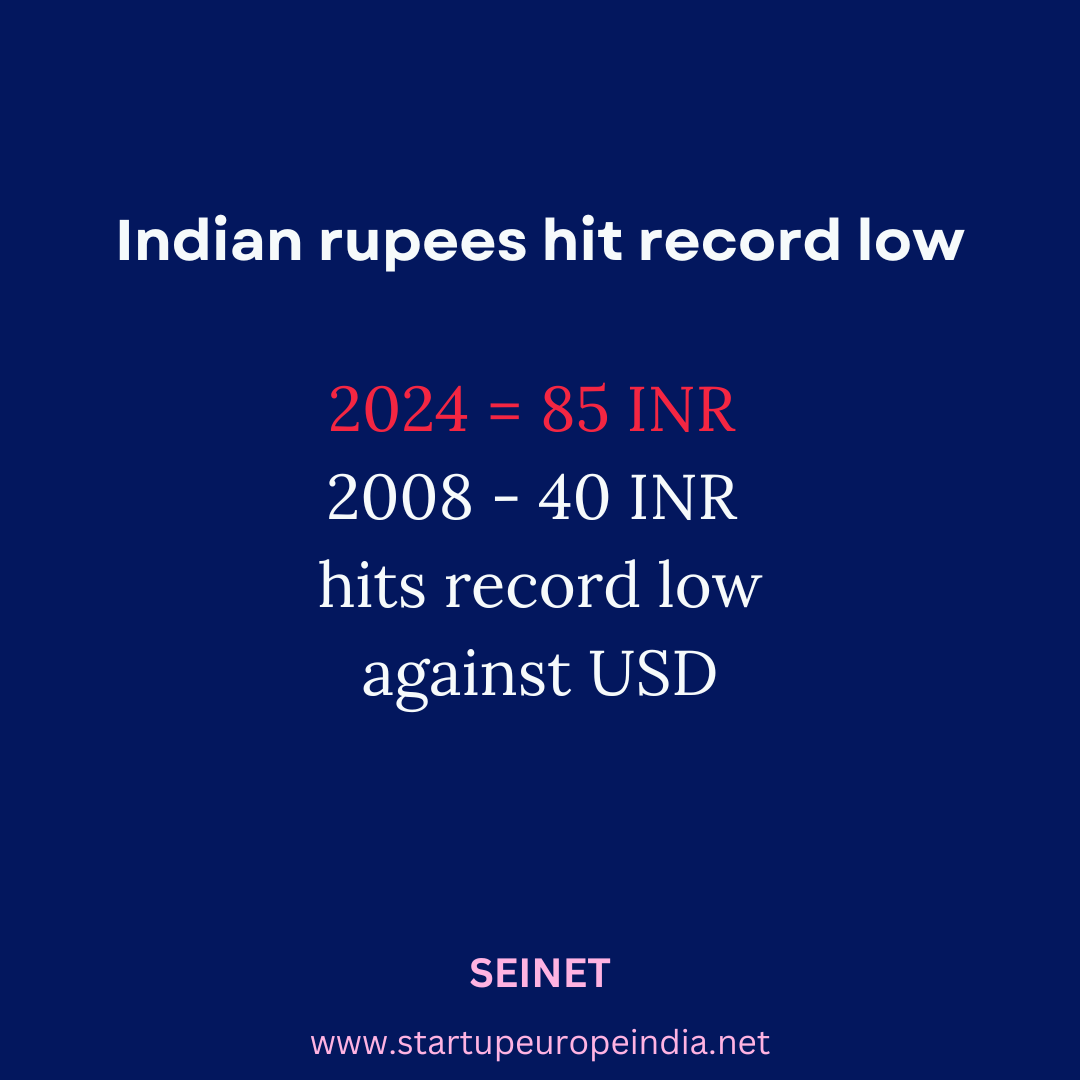
The Indian rupee has been on a downward trajectory against the US dollar, recently hitting a record low of approximately INR 85/USD. This depreciation reflects a confluence of domestic economic challenges and global financial dynamics. Understanding the reasons behind this trend and its broader implications requires an exploration of several interconnected factors.
Key Factors Behind the Rupee's Depreciation
1. Trade Imbalance
India has long grappled with a persistent trade deficit, where imports exceed exports. This imbalance increases the demand for US dollars to pay for imports, placing downward pressure on the rupee. Critical imports such as oil and electronics amplify this deficit, as these sectors are heavily reliant on international markets.
2. Capital Outflows
In 2024, foreign institutional investors (FIIs) withdrew over ₹43,000 crore from Indian markets. Such significant outflows reduce demand for the rupee while simultaneously increasing demand for the dollar. This trend underscores the sensitivity of emerging markets like India to global investor sentiment.
3. Stronger US Dollar
The US dollar's global strength has compounded the rupee's depreciation. A robust US economy, coupled with a hawkish stance from the US Federal Reserve, has driven up demand for dollar-denominated assets, making the rupee comparatively weaker.
4. Inflation Differential
India's inflation rate remains higher than that of the US. This inflation differential erodes the purchasing power of the rupee and makes Indian goods less competitive in global markets, contributing to further depreciation.
5. Global Economic Uncertainty
Ongoing geopolitical tensions—such as the Russia-Ukraine conflict and the US-China rivalry—have created an uncertain global economic landscape. In such volatile conditions, investors gravitate toward safe-haven currencies like the US dollar, increasing its demand at the expense of emerging market currencies like the rupee.
6. Interest Rate Differentials
Rising US interest rates attract foreign capital flows into US assets, creating an increased demand for dollars. In contrast, India’s relatively lower interest rates diminish its attractiveness for foreign investments, exacerbating rupee depreciation.
7. Current Account Deficit
India's current account deficit, which reflects the country's higher expenditure on foreign trade than its earnings, has widened in recent years. This imbalance results in a net outflow of domestic currency, weakening the rupee further.
8. Structural Economic Challenges
India's reliance on imports for critical sectors, limited export diversification, and high external debt collectively heighten the rupee's sensitivity to global economic changes. Initiatives like ‘Make in India’ aim to address these issues, but their long-term impact is still unfolding.
The Paradox: Economic Growth Amid Rupee Weakness
Despite the rupee's depreciation, India’s economy remains one of the fastest-growing globally, with GDP projected to expand by 7% in FY 2023-24. This paradox highlights the nuanced interplay between economic growth and currency stability.
Drivers of Economic Growth
- Strong Domestic Consumption: Contributing nearly 70% to GDP.
- Robust Services Sector: Accounting for over 53% of economic output.
- Rising Private Investment: Particularly in real estate and manufacturing.
- Government Infrastructure Spending: Supporting long-term economic resilience.
Challenges to Growth
- Widening Trade and Current Account Deficits: These imbalances divert domestic currency outflows.
- Capital Flight: FIIs withdrawing investments reduces liquidity in domestic markets.
- Inflation Differential: Weakens competitiveness of Indian exports.
Policy Responses and Their Impacts
1. RBI Interventions
The Reserve Bank of India (RBI) has actively intervened in currency markets, selling dollars to stabilize the rupee. While this offers short-term relief, it also reduces domestic liquidity, which could impact overall economic growth.
2. Policy Trade-offs
Balancing inflation control, growth support, and currency stability poses significant challenges for policymakers. Efforts to curb inflation often involve raising interest rates, which can deter investments and slow growth.
3. Structural Reforms
Addressing India’s reliance on imports and diversifying exports are critical to ensuring long-term currency stability. Policies like the Production-Linked Incentive (PLI) schemes are steps in this direction but require sustained execution and investment.
Implications of Rupee Depreciation
- Higher Import Costs: A weaker rupee raises the cost of essential imports, including crude oil, leading to inflationary pressures.
- Export Competitiveness: Depreciation can boost exports by making Indian goods cheaper globally, but subdued global demand may limit this benefit.
- Foreign Investments: A weaker rupee lowers entry costs for foreign investors, but currency risks might deter long-term commitments.
- Consumer Impact: Rising prices for imported goods could erode purchasing power, affecting domestic consumption.
Outlook and Way Forward
The rupee’s depreciation is a symptom of broader economic dynamics. While India’s growth trajectory remains robust, addressing key vulnerabilities is essential to aligning currency stability with economic expansion. Structural reforms, prudent fiscal management, and a strategic approach to global economic headwinds will play pivotal roles.
Upcoming Challenges
- Elections and Policy Shifts: The 2024 elections may bring new economic policies that could influence investor sentiment and currency stability.
- Global Economic Conditions: The interplay between global interest rates, geopolitical tensions, and trade dynamics will remain crucial.
India’s journey to balance economic growth with currency stability underscores the complexities of navigating an interconnected global economy. With the right strategies, the country can leverage its growth potential while mitigating the challenges posed by a depreciating rupee.
---
Join SEINET - the exclusive network for tech and science product and industry leaders. SignUp Free www.startupeuropeindia.net
_<->1708724263995_9Y10OskXA8FdggLg.jpeg?w=3840&q=75)