Thu, Jan 9, 2025

NTPC Green Energy LTD Plans Massive Green Hydrogen Hub in India

Technology
Sarah   J

Sarah J

Posted on Thu, Jan 9, 2025

2 min read

Share the article with your network

x
Facebook
linkedin
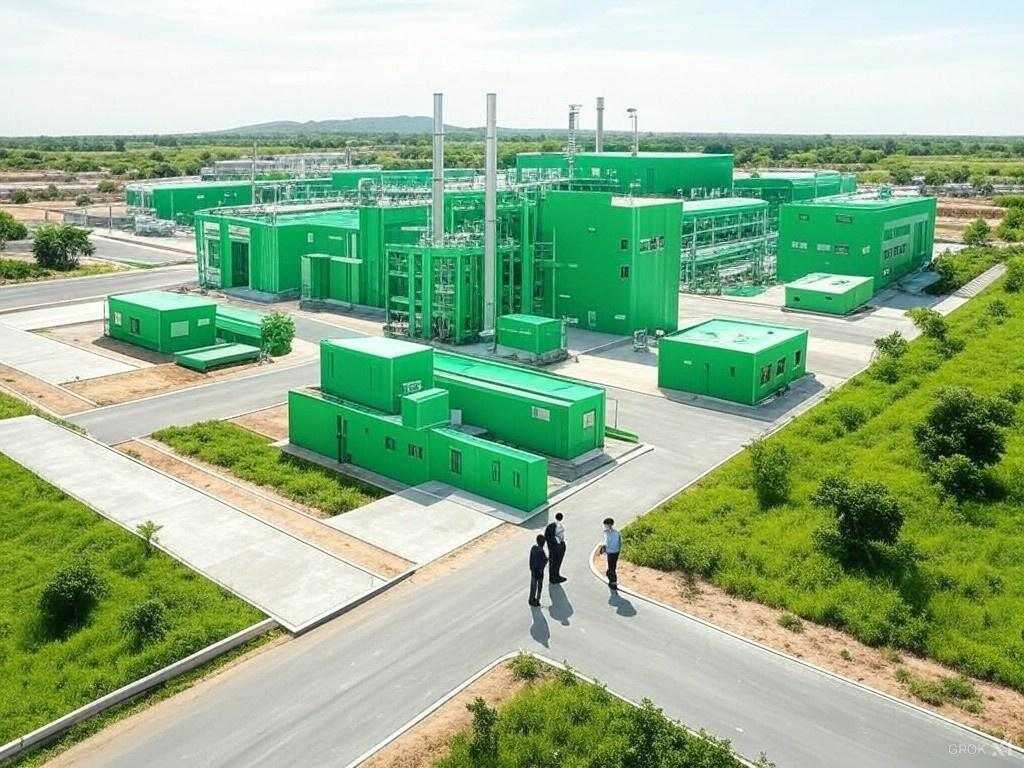
India's NTPC Green Energy is set to develop a $21 billion green hydrogen hub in Andhra Pradesh, marking a significant step in the country's renewable energy transition. This ambitious project, known as the 'NTPC Green Energy LTD Green Hydrogen Hub', will be capable of producing 1,500 tonnes of green hydrogen and 7,500 tonnes of derivatives daily.


- Production capacity: 1,500 tonnes per day of green hydrogen

- Derivative production: 7,500 tonnes per day

- Renewable energy capacity: 20GW

- Location: Pudimadaka, Andhra Pradesh

- Estimated cost: $21 billion


The hub will focus on producing green derivatives such as green methanol, green urea, and sustainable aviation fuel (SAF), primarily for export markets. This aligns with India's National Green Hydrogen Mission and contributes to the country's target of 500GW renewable energy capacity by 2030.


The project's announcement by Prime Minister Narendra Modi underscores India's commitment to strengthening existing green energy solutions. It follows the country's recent fulfillment of various Paris Agreement commitments.


This development comes amid surging hydrogen demand in India, as evidenced by the oversubscription of the country's latest green hydrogen auction. The auction received bids for 626,500 tonnes annually, exceeding the 450,000-tonne cap, highlighting the growing interest in green hydrogen production.


The NTPC Green Energy LTD Green Hydrogen Hub represents a significant stride in India's efforts to become a global leader in green hydrogen production and utilization, potentially reshaping the country's energy landscape and export capabilities.


---

Join the exclusive network for growth companies and corporates driving growth and partnerships in tech and science www.startupeuropeindia.net


You may also like

Sarah   J

Sarah J

Tue, Jan 27, 2026

Beyond the Pill: The Rise of India’s CDMO Architects

For decades, the story of Indian pharma was written in the language of "volume." It was the "pharmacy of the world" - a massive, low-cost engine churning out millions of generic tablets as a quiet subcontractor for Western brands. But a quieter, more sophisticated revolution has reached its tipping point in 2026. The sector is shedding its image as a mere factory for hire and emerging as a high-stakes architectural firm for drug development.Leading this charge is Akums Drugs & Pharmaceuticals, a company that mirrors the broader Indian arc: a journey from a cost-competitive domestic manufacturer to a global, innovation-led partner.The Evolution: From Filling Orders to Designing SolutionsThe transition of Akums follows a classic industrial "climb" that parallels how global manufacturing leaders shift from generic production to value-added services. By moving from OEM (Original Equipment Manufacturer) to a strategic partner, Akums has fundamentally changed its value proposition through three distinct eras:The Scale-Up (2004–2010): Focus on high-volume oral solids (tablets and capsules) for the Indian domestic market, competing on price and manufacturing efficiency.The Quality Pivot (2011–2020): Aggressive investment in GMP-aligned facilities. The company secured approvals from the WHO, EU-GMP, and ANVISA (Brazil), satisfying Western regulatory rigors to expand beyond local borders.The "D" in CDMO (2021–Present): Shift from taking orders to offering formulation development, stability testing, and clinical trial supplies. With four DSIR-approved R&D centers and a library of over 4,200 commercialized formulations, they now function as a technical extension of global pharma brands.The New Architecture: India’s CDMO Landscape in 2026The shift from "volume" to "value" is best understood by comparing the champions of this space. While traditional titans like Divi’s dominate in chemical synthesis, the new wave of CDMOs focuses on complex research and integrated manufacturing.Akums Drugs & Pharmaceuticals: Market Cap of ~$798 million (as of Jan 27, 2026). Specialized in complex formulations with 140+ patents. Their current focus is on specialized modalities like extended-release "tablet-in-tablet" technology.Divi’s Laboratories: Market Cap of ~$19.1 billion. The undisputed leader in API (Active Pharmaceutical Ingredient) and custom synthesis, maintaining high margins through massive economies of scale.Syngene International: Market Cap of ~$3.0 billion. An integrated CRDMO (Contract Research, Development, and Manufacturing Organization), heavily invested in biologics with a significant presence in the US to service global biotech firms.Financial and Market Profile: A 2026 SnapshotAs of January 2026, Akums stands as a symbol of the sector’s maturity. Following its 2024 IPO, the company has navigated a complex global "reset" in pharma spending. (Figures converted at $1 = ₹83.5).Revenue Resilience: For H1 FY26 (ending Sept 2025), Akums reported revenue of $244.5 million. Despite a slight 1.5% YoY revenue dip in Q2 due to falling API prices, core CDMO volumes grew by 7%, outpacing the broader industry.Profitability Trends: The company reported a Net Profit of $5.1 million in Q2 FY26. While the EBITDA margin dipped to 9.3% (from 12.6% in Q1), management expects a recovery to the 12-14% range in the second half of the year as newer facilities ramp up.Global Footprint & Guaranteed Offtake: In late 2025, Akums began construction on a $45 million pharmaceutical plant in Zambia (Akums holds a 51% stake). Crucially, the Zambian government has committed to purchasing $50 million worth of medicines from Akums’ Indian facilities across 2026 and 2027 while the plant is under construction.The "EU-GMP" Crucible and AI-Led ComplianceThe European market is the primary battleground for high-margin contracts. In January 2026, Akums received EU-GMP renewal for its Plant 1 and first-time certification for its Plant 2 in Haridwar.This regulatory green light from the Bulgarian Drug Agency is the key to unlocking a landmark €200 million (~$217 million) European supply contract signed in December 2024. To service this and future Western contracts through 2027, Akums is deploying "Pharma 4.0" digital quality tools:Predictive Quality Assurance: Integrating AI with Manufacturing Execution Systems (MES) to detect anomalies in process parameters (temperature, pressure) before batch failures occur.Computer Vision for Visual Inspection: Automated AI systems that identify packaging and product defects with higher precision than human operators, meeting stringent EU standards.Digital Audit Readiness: Paperless workflows and AI-powered document management to ensure "Data Integrity" remains beyond reproach during unannounced regulatory audits.2027 Risk Assessment: The Geopolitical CrucibleWhile European expansion (EU-GMP) and African infrastructure provide a buffer, the United States remains a high-stakes geography.The "Tariff Bombshell": Proposed US tariffs under Section 232 pose a risk. However, standard generics - which account for 90% of US prescriptions -remain largely insulated to avoid domestic drug shortages and public health crises.The Biosecure Act Opportunity: The US Biosecure Act (passed into the NDAA for 2026) mandates a decoupling from Chinese biotechnology "companies of concern." This is expected to trigger a multi-billion dollar shift in contracts, with Indian CDMOs positioned as the primary "China-plus-one" beneficiaries.From Workhorse to ArchitectThe Indian CDMO sector is projected to reach $29.53 billion by the end of 2026, growing at a CAGR of 14.4%. This growth is no longer driven by "more of the same," but by high-value partnerships in biologics, peptides, and sterile injectables.Akums' journey - from a local manufacturer to a partner supplying life-saving medications to Switzerland, Germany, and Zambia - reflects the transition of Indian pharma from capacity to capability. As Western pharma faces rising R&D costs and trade friction, the Indian CDMO has become their most vital collaborator: the firm that knows how to make medicine both innovative and accessible."The renewal of EU GMP certification for Plant 1 and the new certification for Plant 2 strengthen our ability to serve regulated markets with confidence and support our long-term partnerships and sustained global growth." — Sandeep Jain, MD, Akums Drugs & Pharmaceuticals (January 23, 2026). The Economic Times.----Join SEINET - the digital platform building the European, UK and Indian corporate and startup leaders ecosystem to accelerate growth and partnerships between the markets. Become part of a trusted ecosystem of business and innovation leaders from Airbus, Microsoft, Eli Lilly and others. Request to join www.startupeuropeindia.net
Tue, Jan 27, 2026
Beyond the Pill: The Rise of India’s CDMO Architects
Sarah   J

Sarah J

Tue, Jan 27, 2026

India and EU Seal Landmark Free Trade Agreement, Slashing Billions in Tariffs

India and the European Union have concluded a long-awaited Free Trade Agreement (FTA), marking one of the most significant trade pacts ever signed by either side.The deal, finalised during a high-level India-EU Summit, is expected to eliminate or reduce up to €4 billion in tariffs on EU exports and substantially boost bilateral trade flows.The agreement will reduce or phase out tariffs on 96.6% of EU exports to India, covering key sectors such as automobiles, alcohol, machinery, chemicals, pharmaceuticals, steel and iron products. At the same time, sensitive agricultural sectors on both sides including dairy, sugar, meat, rice and ethanol have been excluded to protect domestic interests.European Commission President Ursula von der Leyen, speaking alongside Indian Prime Minister Narendra Modi, described the pact as the “mother of all trade deals”, highlighting its scale and strategic importance. She called the agreement a partnership between two major global economic powers the world’s second-largest and fourth-largest economies.Prime Minister Modi hailed the deal as the beginning of a “new era” in India-EU relations, stating that it would improve access to European markets for Indian farmers, MSMEs and exporters, while also attracting greater investment into India.Major Tariff Reductions Across Key SectorsUnder the agreement:EU car tariffs in India will be gradually reduced from 110% to 10%, with an annual quota of 250,000 vehicles.Tariffs of up to 44% on machinery, 22% on chemicals, 11% on pharmaceuticals, and 22% on steel and iron will be largely eliminated over time.Wine tariffs will fall sharply from 150% to 75%, and eventually to around 20%, while olive oil tariffs will drop from 45% to zero within five years.Levies on processed food products such as bread and confectionery currently as high as 50% will be removed.In return, over 99% of Indian exports, valued at approximately $75 billion, will gain preferential access to the EU market. Key Indian sectors expected to benefit include textiles, gems and jewellery, pharmaceuticals, engineering goods and chemicals. Notably, EU duties on Indian textiles previously exceeding 10% will be reduced to zero.Boost to Trade, Investment and Strategic AlignmentThe European Union is currently India’s largest trading partner, with bilateral trade in goods and services exceeding €180 billion annually. Officials expect the new agreement to potentially double EU exports to India over time, while strengthening supply chains and regulatory cooperation.The deal also includes commitments to streamline customs procedures, improve regulatory coordination, and enhance cooperation on standards steps expected to reduce trade friction and costs for businesses on both sides.In a significant climate-related move, the EU has pledged €500 million to support India’s industrial decarbonisation efforts, addressing concerns over the bloc’s upcoming carbon border tax on products such as steel and chemicals. While European industry groups broadly welcomed the agreement, some sectors expressed caution. The EU steel industry has raised concerns over trade imbalances, while politically sensitive sectors - such as India’s dairy industry and several EU agricultural segments were deliberately excluded from the pact. The agreement will now undergo approval by the European Parliament, EU member states, and India’s Cabinet before entering into force. Once implemented, it will become one of the most comprehensive trade agreements India has signed, aligning with New Delhi’s broader push to expand trade ties covering over half of India’s global trade.read more: https://ec.europa.eu/commission/presscorner/detail/en/ip_26_184-------Join SEINET - the digital platform connecting European, UK and Indian corporate and startup leaders to accelerate growth and partnerships between the markets. Become part of a trusted ecosystem of business and innovation leaders. Request to join www.startupeuropeindia.net
Tue, Jan 27, 2026
India and EU Seal Landmark Free Trade Agreement, Slashing Billions in Tariffs
Sarah   J

Sarah J

Sun, Jan 25, 2026

CBAM and the New Reality of EU–India Trade

How the EU’s Carbon Border Adjustment Mechanism has moved from theory to enforcement - and why it now sits at the centre of EU–India economic negotiations.CBAM: from climate policy to trade realityThe Carbon Border Adjustment Mechanism (CBAM) is no longer a future policy experiment. As of January 2026, it has entered its implementation phase and is now a concrete cost, compliance and strategic issue for exporters into the European Union. For India, this marks a turning point: CBAM is no longer just a climate discussion, but a live trade issue shaping negotiations, supply chains and pricing decisions.At its core, CBAM applies a carbon price to certain imported goods to reflect the cost EU producers already face under the EU Emissions Trading System (ETS). The objective is simple and explicit: prevent carbon leakage and ensure that climate ambition inside the EU is not undercut by cheaper, higher-emission imports from abroad.What exactly is CBAM?CBAM requires EU importers to account for the greenhouse gas emissions embedded in specific categories of goods. When fully phased in, importers must surrender CBAM certificates corresponding to those emissions. The certificate price mirrors the EU ETS carbon price. If a carbon price has already been paid in the country of origin, that amount can be deducted, subject to verification.CBAM currently covers highly carbon-intensive sectors: iron and steel, cement, aluminium, fertilisers, electricity and hydrogen. These sectors matter disproportionately in global trade - and several are core export categories for India.The critical shift in 2026Between 2023 and 2025, CBAM operated in a transition phase. Importers were required to report emissions, but no financial adjustment applied. That period is now over.From January 2026, CBAM moved into its definitive phase. Reporting is no longer a dry-run exercise; it is part of an enforcement framework integrated with EU customs systems. While some elements, such as the full phase-out of free ETS allowances, will be gradual through the early 2030s, CBAM is now operational in principle. For exporters, the message is clear: emissions data quality, verification and cost exposure now directly affect access to the EU market.Why CBAM matters specifically for IndiaIndia is not being singled out, but it is unavoidably exposed. The EU is one of India’s largest trading partners, and several CBAM-covered sectors feature prominently in bilateral trade.The immediate implications are threefold.First, cost and competitiveness. Indian exporters whose products have high embedded emissions face a potential price disadvantage unless they can demonstrate lower carbon intensity or deduct an equivalent domestic carbon price. In sectors like steel and fertilisers, even a modest carbon price can materially affect margins.Second, data and compliance. CBAM is as much a reporting regime as a pricing mechanism. Exporters must produce credible, auditable emissions data aligned with EU methodologies. This requires new monitoring, reporting and verification (MRV) capabilities - often across complex, multi-tier supply chains.Third, strategic positioning. CBAM shifts the basis of competition. Price alone is no longer enough; carbon efficiency becomes a trade asset. Firms that invest early in cleaner processes are better positioned not only for EU market access, but for future trade regimes that may follow similar logic.CBAM and EU–India trade negotiationsCBAM has inevitably entered the centre of EU–India trade discussions, including the long-running negotiations toward a free trade agreement (FTA).From the EU’s perspective, CBAM is non-negotiable in principle. It is embedded in EU climate law and tied to the integrity of the ETS. From India’s perspective, CBAM raises concerns about fairness, development space and administrative burden, particularly for emerging-market producers.The negotiation space lies in the details. India is pushing for clarity on how domestic climate policies - present and future - can be recognised under CBAM. Technical cooperation on emissions accounting, transitional support for exporters and predictable implementation timelines are now key discussion points. CBAM, in this sense, has become a lever: not a tariff to be bargained away, but a framework within which trade concessions, cooperation and equivalence may be negotiated.The broader signal CBAM sendsBeyond EU–India relations, CBAM signals a deeper shift in global trade governance. Environmental performance is being hard-wired into market access. This does not replace traditional trade rules, but it increasingly overlays them.For India, this creates a strategic choice. One path is defensive: minimise short-term disruption and seek carve-outs. The other is forward-looking: treat CBAM as an external pressure that accelerates domestic decarbonisation, strengthens export competitiveness and aligns Indian industry with the direction of global regulation.What exporters should do nowFor companies exporting to the EU, CBAM is no longer abstract. Practical steps are needed:Map exposure to CBAM-covered products and inputsBuild reliable emissions data systems aligned with EU rulesAssess cost impacts under different carbon price scenariosEngage early with EU importers, who carry the formal CBAM obligationsInvest in efficiency and low-carbon processes where feasibleWaiting for policy clarity is no longer a viable strategy. The compliance clock has started.The bottom lineCBAM marks a structural change in how the EU trades with the world. For India, it is both a challenge and an opportunity. The challenge is immediate: higher compliance costs and tougher market access conditions. The opportunity lies in using this moment to modernise industrial processes, strengthen negotiating leverage and position Indian exporters for a carbon-constrained global economy.CBAM is not a passing regulation. It is a preview of how climate policy and trade policy are converging - and EU–India economic relations will increasingly be shaped at that intersection.-------SEINET is the go-to-market (GTM) and strategic partnership platform that connects corporate and startup leaders, enabling cross-border collaboration, market expansion, and long-term growth between Europe and India. Request to Join for Free www.startupeuropeindia.net
Sun, Jan 25, 2026
CBAM and the New Reality of EU–India Trade