How the EU’s Carbon Border Adjustment Mechanism has moved from theory to enforcement - and why it now sits at the centre of EU–India economic negotiations.
CBAM: from climate policy to trade reality
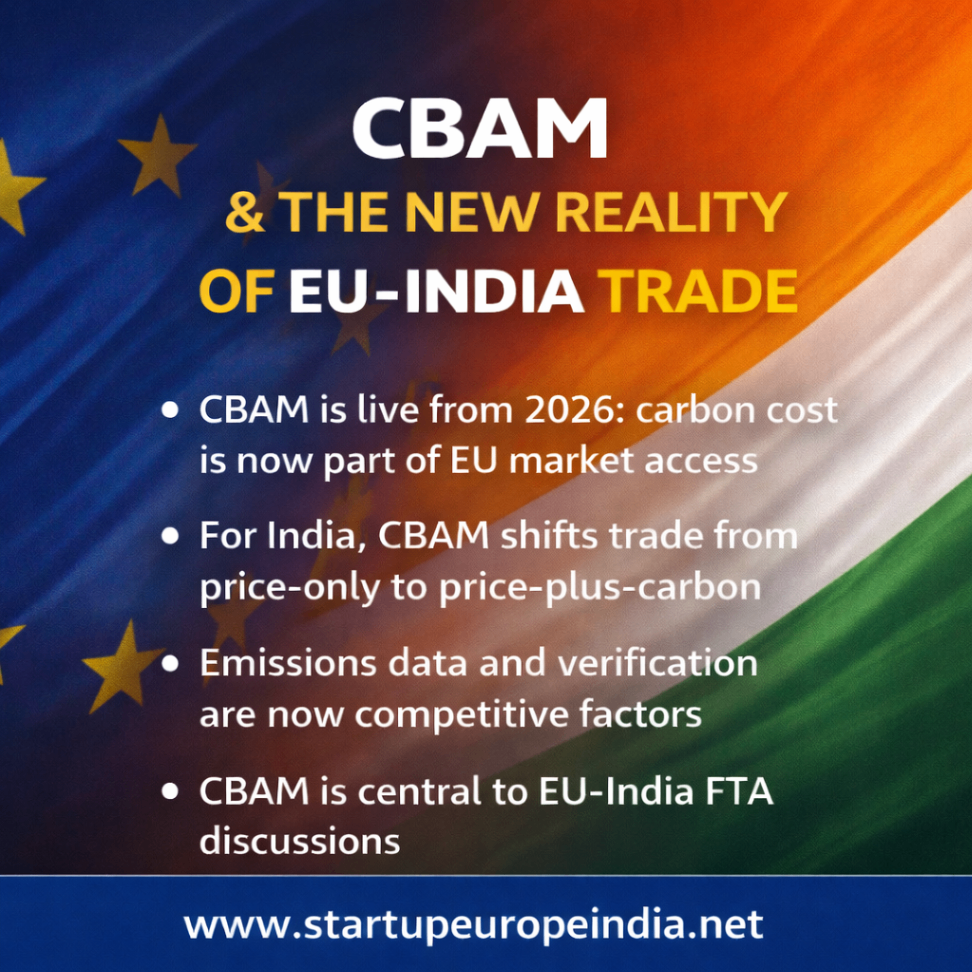
The Carbon Border Adjustment Mechanism (CBAM) is no longer a future policy experiment. As of January 2026, it has entered its implementation phase and is now a concrete cost, compliance and strategic issue for exporters into the European Union.
For India, this marks a turning point: CBAM is no longer just a climate discussion, but a live trade issue shaping negotiations, supply chains and pricing decisions.
At its core, CBAM applies a carbon price to certain imported goods to reflect the cost EU producers already face under the EU Emissions Trading System (ETS). The objective is simple and explicit: prevent carbon leakage and ensure that climate ambition inside the EU is not undercut by cheaper, higher-emission imports from abroad.
What exactly is CBAM?
CBAM requires EU importers to account for the greenhouse gas emissions embedded in specific categories of goods. When fully phased in, importers must surrender CBAM certificates corresponding to those emissions. The certificate price mirrors the EU ETS carbon price. If a carbon price has already been paid in the country of origin, that amount can be deducted, subject to verification.
CBAM currently covers highly carbon-intensive sectors: iron and steel, cement, aluminium, fertilisers, electricity and hydrogen. These sectors matter disproportionately in global trade - and several are core export categories for India.
The critical shift in 2026
Between 2023 and 2025, CBAM operated in a transition phase. Importers were required to report emissions, but no financial adjustment applied. That period is now over.
From January 2026, CBAM moved into its definitive phase. Reporting is no longer a dry-run exercise; it is part of an enforcement framework integrated with EU customs systems. While some elements, such as the full phase-out of free ETS allowances, will be gradual through the early 2030s, CBAM is now operational in principle. For exporters, the message is clear: emissions data quality, verification and cost exposure now directly affect access to the EU market.
Why CBAM matters specifically for India
India is not being singled out, but it is unavoidably exposed. The EU is one of India’s largest trading partners, and several CBAM-covered sectors feature prominently in bilateral trade.
The immediate implications are threefold.
First, cost and competitiveness. Indian exporters whose products have high embedded emissions face a potential price disadvantage unless they can demonstrate lower carbon intensity or deduct an equivalent domestic carbon price. In sectors like steel and fertilisers, even a modest carbon price can materially affect margins.
Second, data and compliance. CBAM is as much a reporting regime as a pricing mechanism. Exporters must produce credible, auditable emissions data aligned with EU methodologies. This requires new monitoring, reporting and verification (MRV) capabilities - often across complex, multi-tier supply chains.
Third, strategic positioning. CBAM shifts the basis of competition. Price alone is no longer enough; carbon efficiency becomes a trade asset. Firms that invest early in cleaner processes are better positioned not only for EU market access, but for future trade regimes that may follow similar logic.
CBAM and EU–India trade negotiations
CBAM has inevitably entered the centre of EU–India trade discussions, including the long-running negotiations toward a free trade agreement (FTA).
From the EU’s perspective, CBAM is non-negotiable in principle. It is embedded in EU climate law and tied to the integrity of the ETS. From India’s perspective, CBAM raises concerns about fairness, development space and administrative burden, particularly for emerging-market producers.
The negotiation space lies in the details. India is pushing for clarity on how domestic climate policies - present and future - can be recognised under CBAM. Technical cooperation on emissions accounting, transitional support for exporters and predictable implementation timelines are now key discussion points. CBAM, in this sense, has become a lever: not a tariff to be bargained away, but a framework within which trade concessions, cooperation and equivalence may be negotiated.
The broader signal CBAM sends
Beyond EU–India relations, CBAM signals a deeper shift in global trade governance. Environmental performance is being hard-wired into market access. This does not replace traditional trade rules, but it increasingly overlays them.
For India, this creates a strategic choice. One path is defensive: minimise short-term disruption and seek carve-outs. The other is forward-looking: treat CBAM as an external pressure that accelerates domestic decarbonisation, strengthens export competitiveness and aligns Indian industry with the direction of global regulation.
What exporters should do now
For companies exporting to the EU, CBAM is no longer abstract. Practical steps are needed:
- Map exposure to CBAM-covered products and inputs
- Build reliable emissions data systems aligned with EU rules
- Assess cost impacts under different carbon price scenarios
- Engage early with EU importers, who carry the formal CBAM obligations
- Invest in efficiency and low-carbon processes where feasible
Waiting for policy clarity is no longer a viable strategy. The compliance clock has started.
The bottom line
CBAM marks a structural change in how the EU trades with the world. For India, it is both a challenge and an opportunity. The challenge is immediate: higher compliance costs and tougher market access conditions. The opportunity lies in using this moment to modernise industrial processes, strengthen negotiating leverage and position Indian exporters for a carbon-constrained global economy.
CBAM is not a passing regulation. It is a preview of how climate policy and trade policy are converging - and EU–India economic relations will increasingly be shaped at that intersection.
-------
SEINET is the go-to-market (GTM) and strategic partnership platform that connects corporate and startup leaders, enabling cross-border collaboration, market expansion, and long-term growth between Europe and India.
Request to Join for Free www.startupeuropeindia.net
_<->1708724263995_9Y10OskXA8FdggLg.jpeg?w=3840&q=75)