Sun, Apr 13, 2025

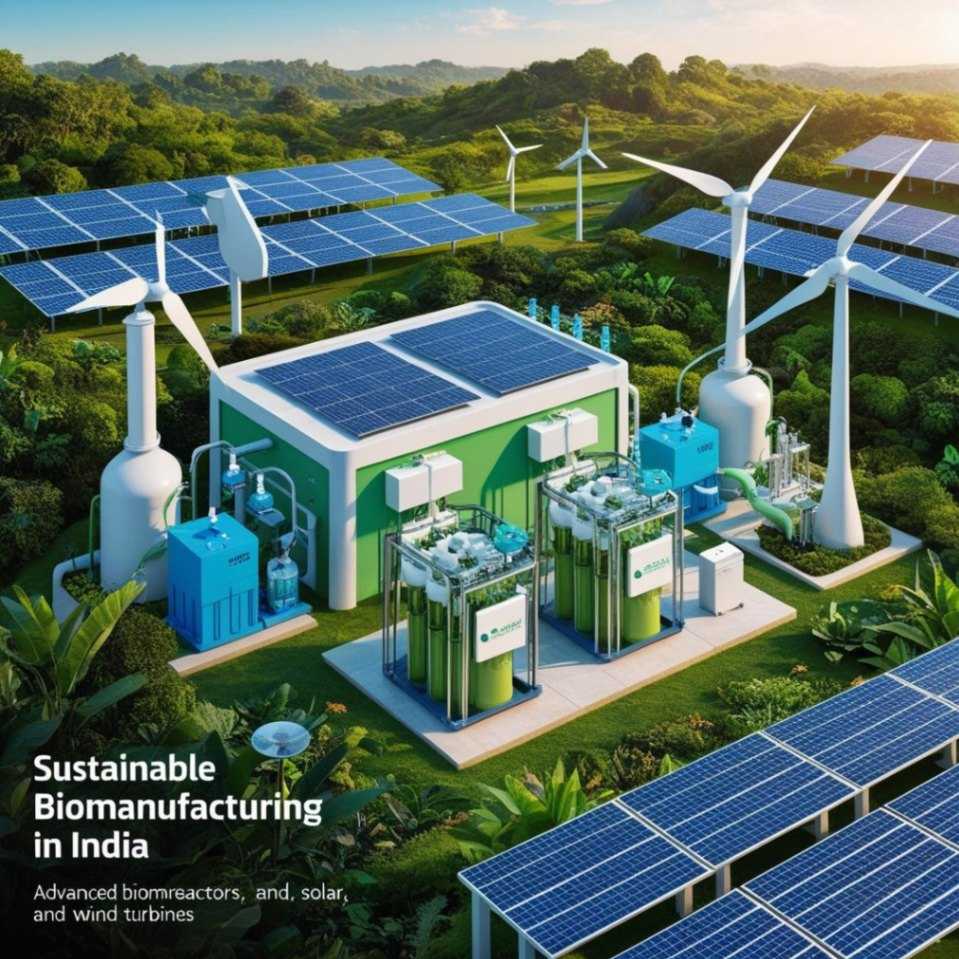
Sustainable Biomanufacturing: Paving the Way for India's Green Transition

India
Team S

Team S

Posted on Sun, Apr 13, 2025

3 min read

Share the article with your network

x
Facebook
linkedin

India is at a critical juncture in its industrial journey, where balancing rapid growth with environmental sustainability is more important than ever. As the country’s chemical industry is projected to reach $304 billion by 2025, adopting sustainable biomanufacturing and green chemistry practices has emerged as a key strategy to address climate challenges while boosting economic competitiveness.


The Plastic Challenge and Circular Economy Opportunities

Plastics have revolutionized modern life due to their affordability and versatility, but their environmental impact is alarming. Global plastic production stands at 350 million metric tons annually and could triple by 2050. Most plastics, including polyethylene terephthalate (PET), are derived from fossil-based materials, contributing significantly to pollution as only 15% of PET is recycled. The rest ends up in landfills or the environment.


Innovative solutions like the one proposed by Kopperi and colleagues offer hope. Their research introduces an eco-friendly method to convert waste PET into biofuel blends using alkali-catalyzed depolymerization followed by microbial conversion in a bioelectrochemical system. This process not only reduces waste but also lowers carbon emissions, demonstrating the potential of green chemistry to transform traditional recycling methods into sustainable alternatives.


Why Green Chemistry Matters for India

Sustainable chemistry goes beyond pollution reduction; it focuses on designing processes that inherently avoid hazardous substances. For India, which faces rising environmental pressures alongside industrial expansion, such innovations are crucial. By leveraging biomanufacturing techniques, India can reduce dependency on fossil fuels, cut costs, and unlock new revenue streams through circular economy models.

For example, transitioning to biobased polymers or solvent-free processes can help businesses align with global sustainability goals while benefiting from regulatory incentives and growing consumer demand for eco-friendly products.


Economic Potential of Biomanufacturing

India’s chemical industry heavily relies on fossil fuel inputs, which not only increase costs but also limit growth opportunities. Biomanufacturing offers a solution by utilizing locally available feedstock to produce high-value chemicals sustainably. This approach aligns with the BioE3 Policy—a government initiative aimed at fostering high-performance biomanufacturing and positioning India as a global leader in biotechnology.


The policy emphasizes innovation-driven research, establishment of biomanufacturing hubs, and workforce development to accelerate technology adoption. By focusing on sectors like specialty chemicals, smart proteins, and climate-resilient agriculture, India can create jobs while addressing pressing environmental challenges.


Overcoming Adoption Barriers

Despite its promise, biomanufacturing faces hurdles such as high upfront costs and resistance from legacy industries. Smart policy interventions like green subsidies, carbon pricing, and mandatory life cycle assessment reporting could help overcome these barriers. Additionally, investment in research and development is essential to scale emerging technologies and ensure profitability aligns with sustainability.


A Strategic Imperative for India's Future

The shift to sustainable chemical manufacturing is not just an environmental necessity but also a strategic economic lever for India. By embracing green chemistry and biomanufacturing today, businesses can gain a competitive edge while contributing to a cleaner future. As India transitions toward a regenerative bioeconomy under initiatives like the BioE3 Policy, it has the opportunity to lead globally in sustainable innovation and economic growth.


This transformative journey will require collaboration across government, industry, and academia to unlock new avenues for sustainability while ensuring that India’s industrial future remains both prosperous and environmentally responsible.

------

Join the Premier Europe-India Network for Tech and Science Leaders


Discover opportunities to connect with industry and product leaders from Europe and India through the Startup Europe India Network (SEINET). This invite-only platform is designed for decision-makers in science, technology, and innovation to drive partnerships, expand markets, and foster mergers and acquisitions.


Register now at www.startupeuropeindia.net

You may also like

Sarah   J

Sarah J

Tue, Mar 31, 2026

India's Zero-Commission Ride-Hailing Platform Takes Its Model to Europe

The Hindu reports that Moving Tech Innovations, the Bengaluru-based company behind Namma Yatri, has acquired Netherlands-based Automicle Holding BV in its first international move, marking a direct push into the European urban mobility market.The deal, announced on March 26, gives Moving Tech a foothold on the continent with a platform that already works with European city authorities on digital parking systems and integrated public transport. Financial terms were not disclosed.The strategic rationale is straightforward: European ride-hailing remains dominated by platforms that charge drivers commissions of anywhere between 10 and 50%. Moving Tech's entire model is built around eliminating that layer. Across its Indian platforms, including Namma Yatri, Yatri Sathi, and Bharat Taxi, the company has completed over 150 million trips and channelled more than Rs 2,500 crore in earnings directly to drivers without taking a cut."When we built Namma Yatri, we put cities and their people first," said co-founders Magizhan Selvan and Shan MS. "These are not local solutions; they are universal principles. Cities everywhere are seeking a mobility model that is open and community-led."Automicle's co-founders framed the deal as a two-way exchange, with European expertise in parking and integrated urban transport flowing back to Indian cities alongside Moving Tech's open-network model heading west.The acquisition follows a pre-Series A extension round in which Namma Yatri raised Rs 39.75 crore, roughly $4.4 million, with participation from Juspay founder Vimal Kumar. The company also pointed to renewed momentum in India-EU Free Trade Agreement talks as broader context for the move.
Tue, Mar 31, 2026
1
India's Zero-Commission Ride-Hailing Platform Takes Its Model to Europe
Sarah   J

Sarah J

Tue, Mar 31, 2026

Europe Looks to India as a Launch Partner, With Starlink Rivalry as Backdrop

EUToday reports that Eutelsat, Europe's main competitor to SpaceX's Starlink, is in active talks with the Indian Space Research Organisation about future satellite launches, as the company works to reduce its dependence on any single provider.Eutelsat CEO Jean-Francois Fallacher confirmed to Reuters that negotiations with ISRO are ongoing, though no deal has yet been reached. The push for diversification is partly a product of circumstance. The company lost access to Russia's Soyuz rocket following Moscow's invasion of Ukraine, and has since relied on SpaceX and Europe's Ariane rockets.India is a natural fit. ISRO had already launched 72 OneWeb satellites on its LVM3 rocket before Eutelsat's 2023 merger with OneWeb, which means there is an established track record to build on. Fallacher visited New Delhi in February as part of President Macron's delegation, meeting India's telecoms minister and regulators to discuss market access. Macron had previously framed European reliance on non-European launch providers as "madness."The commercial logic is straightforward. Eutelsat estimates its 440-satellite Airbus programme will cost around 2 billion euros by 2030, with launches typically accounting for 30 to 40% of total programme costs, making competitive launch options a significant financial variable.The company is fully financed through 2031 after a 5 billion euro refinancing that made the French state its largest shareholder. For India, the talks reinforce its growing standing as a serious commercial launch provider, with ambitions to grow its space economy to around $44 billion by 2033.
Tue, Mar 31, 2026
Europe Looks to India as a Launch Partner, With Starlink Rivalry as Backdrop
Sarah   J

Sarah J

Tue, Mar 31, 2026

India Partners With Alibaba.com on Exports, Keeping Consumer Bans in Place

India Quietly Partners With Alibaba.com on Exports, Keeping Consumer Bans in PlaceTechCrunch reports that India's government has teamed up with Alibaba.com on an export-focused program through its Startup India initiative, enlisting Indian startups to help onboard small manufacturers and traders onto the Chinese B2B platform's global marketplace.The move is notable given the backdrop. India banned dozens of Chinese-linked apps in 2020 following a deadly border clash, including TikTok, PUBG Mobile, and AliExpress, which is also an Alibaba Group product. Those bans remain in force. The new Alibaba.com partnership, however, is being treated as a separate category of engagement entirely, focused on exports rather than consumer access.Micro, small, and medium enterprises account for nearly half of India's exports and about 31% of GDP, which explains why New Delhi is willing to work with a Chinese-linked platform when the commercial case is strong enough. Alibaba.com's B2B platform connects more than 50 million active buyers across over 200 countries and regions, giving Indian exporters reach they would be hard pressed to find elsewhere.Policy analysts quoted in the piece frame the distinction as deliberate. George Chen, partner at The Asia Group, noted that China itself bans foreign consumer apps while still allowing those same companies to serve Chinese exporters, and India appears to be drawing lessons from that model.The collaboration follows Alibaba.com launching its Trade Assurance program in India in June 2025 and comes ahead of an India AI Impact Summit in New Delhi where Chinese representatives are expected to attend, suggesting a cautious but real thaw in certain corners of the India-China tech relationship.
Tue, Mar 31, 2026
India Partners With Alibaba.com on Exports, Keeping Consumer Bans in Place