Back to news
Sun, Apr 27, 2025
Artificial Intelligence

India’s Tech Talent Embraces the AI Revolution

Sarah J3 min read
India’s Tech Talent Embraces the AI Revolution

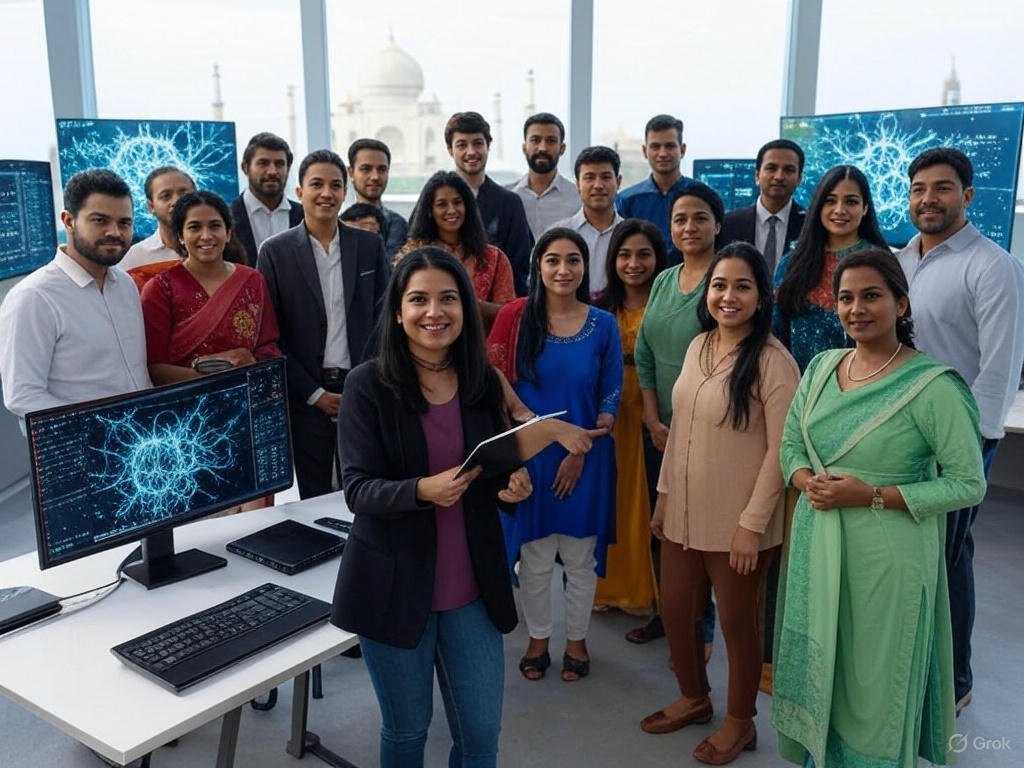
India’s technology sector, long a global powerhouse for IT services and software development, is undergoing a seismic shift as artificial intelligence (AI) reshapes the industry. With a workforce of over 5 million tech professionals and a burgeoning startup ecosystem, the country is rapidly adapting to the AI era, balancing challenges with immense opportunities.


A Workforce in Transition

The rise of AI is transforming job roles across India’s tech landscape. Traditional tasks like coding and data analysis are increasingly augmented by AI tools, pushing professionals to upskill in areas like machine learning, natural language processing, and AI ethics. Companies such as Tata Consultancy Services (TCS) and Infosys are investing heavily in reskilling programs, training thousands of employees to work alongside AI systems. For instance, TCS’s AI-focused training initiatives aim to prepare its workforce for “human-AI collaboration,” ensuring employees remain relevant in an automated world.


This shift isn’t limited to large corporations. India’s startup ecosystem, with over 1,200 AI-driven startups, is fostering a culture of innovation. Entrepreneurs and developers are leveraging AI to solve local challenges, from improving agricultural yields to enhancing healthcare diagnostics. This entrepreneurial spirit is supported by government initiatives like the National AI Strategy, which promotes AI adoption and skill development.


Education and Skill Development

India’s education system is also adapting to meet AI-driven demands. Universities and online platforms are introducing specialized AI and data science courses, with institutions like the Indian Institute of Technology (IIT) and Indian Institute of Science (IISc) leading the charge. Meanwhile, edtech platforms like UpGrad and Coursera report a surge in enrollments for AI-related certifications, reflecting a growing appetite among young professionals to master these skills.


However, challenges remain. The pace of AI adoption outstrips the supply of highly skilled talent, creating a gap between industry needs and available expertise. Rural areas, in particular, face barriers to accessing quality education and internet connectivity, limiting participation in the AI economy. Addressing these disparities is critical to ensuring inclusive growth.


Economic and Global Impact

India’s AI adaptation is poised to bolster its $250 billion IT industry. By integrating AI, companies are improving efficiency, reducing costs, and delivering innovative solutions to global clients. For example, Indian firms are developing AI-powered tools for industries like finance, retail, and manufacturing, positioning the country as a leader in AI outsourcing.


Globally, India’s tech talent is gaining recognition for its ability to deliver scalable AI solutions. Multinational corporations, including Google and Microsoft, are expanding their AI research hubs in India, drawn by the country’s vast talent pool and cost advantages. This trend underscores India’s growing influence in shaping the global AI landscape.


Despite the optimism, the AI era brings challenges. Job displacement fears loom large, particularly for roles involving repetitive tasks. Industry leaders emphasize the need for proactive reskilling to mitigate these risks. Additionally, ethical concerns around AI, such as data privacy and algorithmic bias, are prompting discussions on responsible AI development. Indian policymakers and companies are beginning to prioritize frameworks for ethical AI, aligning with global standards.


India’s tech talent is at a pivotal moment, embracing AI as both a challenge and an opportunity. With robust investments in education, government support, and a dynamic startup ecosystem, the country is well-positioned to thrive in the AI era. As one industry expert noted, “India’s ability to adapt and innovate will determine its place in the global AI race.” By fostering collaboration between industry, academia, and government, India is not just keeping pace with the AI revolution—it’s helping shape its future.

---

Join the Premier Europe-India Network for Technology and Science Leaders and Organizations Across Europe, the UK, and India


Register free www.startupeuropeindia.net

You may also like

Sarah   J

Sarah J

Sat, Jul 18, 2026

India has become the third country, after the United States and China, to achieve orbital launch capability through a privately developed rocket

Hyderabad-based Skyroot Aerospace successfully launched Vikram-1, India’s first privately developed orbital launch vehicle, from the Satish Dhawan Space Centre in Sriharikota on July 18, 2026. The rocket lifted off at 12:05:30 p.m. Indian Standard Time as part of Mission Aagaman, meaning “arrival.”Around 15 minutes after launch, Vikram-1 successfully deployed payloads into a low Earth orbit at an altitude of approximately 450 kilometres. ISRO confirmed that two satellites—Skyroot’s SCOPE and a satellite from Grahaa Space—were injected into orbit. Other payloads remained attached to the upper stage to conduct in-orbit experiments.India has operated orbital launch vehicles through the Indian Space Research Organisation since the successful launch of the Rohini satellite aboard SLV-3 in 1980. The significance of Mission Aagaman is that Vikram-1 was developed and launched by a private Indian company, although ISRO and the Indian National Space Promotion and Authorisation Centre provided facilities, technical support, safety oversight and regulatory clearances.The Vikram-1 RocketVikram-1 is a small-satellite launch vehicle standing approximately 22 metres tall. It is designed to carry payloads of up to 350 kilograms into low Earth orbit.The four-stage vehicle consists of three solid-fuel stages and a liquid-fuel orbital adjustment module. Its upper stage is powered by a 3D-printed liquid engine and is designed to support precise orbital deployment. The rocket also incorporates carbon-composite structures, avionics and thermal-protection technologies developed by Skyroot.The Vikram launch-vehicle series is named after Vikram Sarabhai, the scientist widely regarded as the father of India’s space programme.Skyroot is positioning Vikram-1 as a dedicated and rideshare launcher for small satellites requiring customised orbital deployment. The company argues that such missions can provide customers with greater control over launch timing and orbital destination than travelling as secondary payloads on larger rockets.Payloads and ExperimentsThe mission carried multiple customer payloads and in-orbit experiments from Indian and international organisations.ISRO has officially confirmed that two satellites, SCOPE and Grahaa, were successfully placed into low Earth orbit. The remaining payloads were carried on the upper stage for in-orbit experiments.Before launch, the announced mission manifest included:Skyroot’s SCOPE satelliteGrahaa Space’s SOLARAS S3 satelliteA technology demonstration from German space company DCUBEDEmbrace, a robotic arm experiment developed by Cosmoserve Space for orbital-debris captureThe announced manifest also included symbolic payloads: a floral-shaped artwork called Cosmic Bloom and a miniature 18-karat gold rocket honouring Indian scientific figures C.V. Raman, Vikram Sarabhai and A.P.J. Abdul Kalam. These items were listed before launch, but official post-launch statements have not separately confirmed the operational status of every individual experiment.Mission Aagaman was intended to test Vikram-1’s propulsion, avionics, telemetry, stage separation, guidance, navigation and control systems under actual flight conditions. Skyroot described the flight as the first of a planned series of development missions ahead of routine commercial operations.From Vikram-S to Vikram-1Skyroot Aerospace was founded in 2018 by former ISRO engineers Pawan Kumar Chandana and Naga Bharath Daka.The company completed its first spaceflight in November 2022 with Vikram-S, a suborbital technology-demonstration rocket launched under Mission Prarambh. That flight made Skyroot the first private Indian company to launch a rocket into space from Indian soil, although Vikram-S did not enter orbit.Vikram-1 represents a significantly more demanding technical achievement. Reaching orbit requires a rocket not only to climb above Earth’s atmosphere but also to accelerate its payload to the horizontal velocity needed to remain in orbit. The vehicle must complete a carefully timed sequence of propulsion, stage-separation and navigation operations before deploying its payloads.India opened more of its space sector to private participation in 2020 and subsequently established a framework through IN-SPACe for private companies to access ISRO facilities and technical expertise. For Vikram-1, ISRO supported solid-motor casting and testing, liquid-engine testing, vehicle integration, trajectory analysis and launch-pad operations.Reaction and Next StepsPrime Minister Narendra Modi called the successful launch a defining moment in India’s space journey. He said growing private-sector participation was opening new frontiers and accelerating innovation, adding that the achievement would encourage young people to “dream bigger and innovate fearlessly.”Skyroot said Mission Aagaman was a test flight and that it expects to conduct additional development flights before beginning routine commercial launches. The company ultimately aims to provide frequent, dedicated launch services for small satellites.The achievement does not replace India’s longstanding government space-launch capability. Instead, it expands the country’s space ecosystem by demonstrating that an Indian private company can independently develop an orbital-class launch vehicle and successfully place satellites into orbit with institutional support from ISRO and IN-SPACe.Sources: Indian Space Research Organisation, Prime Minister’s Office of India, Reuters, Skyroot Aerospace and Space.com.Image courtesy: Skyroot AerospaceSEINET is an execution focused network for operators building partnerships and growth in EU-India-UK corridor in four key clusters - Space, Deep Tech, Defense and Energy. Apply to sign up www.startupeuropeindia.net
Sat, Jul 18, 2026
India has become the third country, after the United States and China, to achieve orbital launch capability through a privately developed rocket
Sarah   J

Sarah J

Sat, Jul 18, 2026

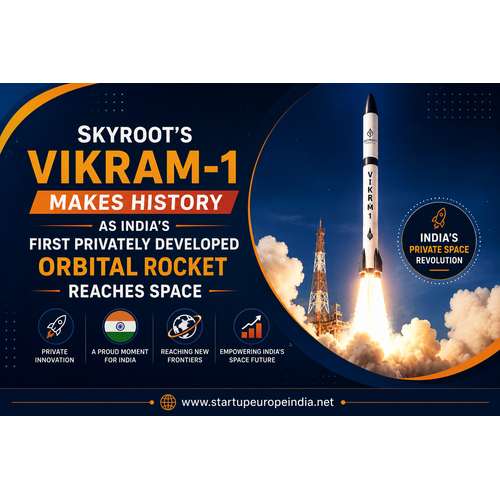
Skyroot's Vikram-1 Makes History as India's First Privately Developed Orbital Rocket Reaches Space

Sat, Jul 18, 2026
Skyroot's Vikram-1 Makes History as India's First Privately Developed Orbital Rocket Reaches Space
Sarah   J

Sarah J

Fri, Jul 17, 2026

India-UK CETA Delivers First US$10 Million Jewellery Export Shipment

Fri, Jul 17, 2026
India-UK CETA Delivers First US$10 Million Jewellery Export Shipment