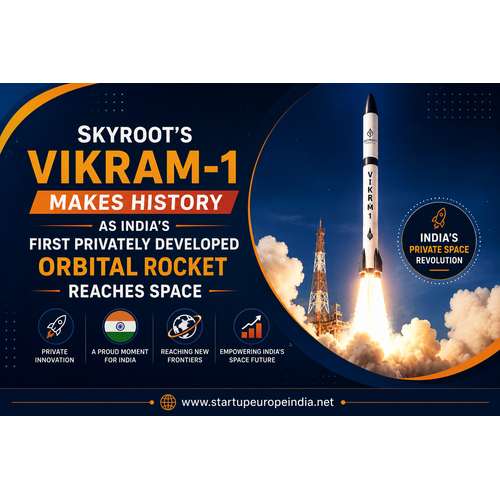
Hyderabad-based Skyroot Aerospace successfully launched Vikram-1, India’s first privately developed orbital launch vehicle, from the Satish Dhawan Space Centre in Sriharikota on July 18, 2026. The rocket lifted off at 12:05:30 p.m. Indian Standard Time as part of Mission Aagaman, meaning “arrival.”
Around 15 minutes after launch, Vikram-1 successfully deployed payloads into a low Earth orbit at an altitude of approximately 450 kilometres. ISRO confirmed that two satellites—Skyroot’s SCOPE and a satellite from Grahaa Space—were injected into orbit. Other payloads remained attached to the upper stage to conduct in-orbit experiments.
India has operated orbital launch vehicles through the Indian Space Research Organisation since the successful launch of the Rohini satellite aboard SLV-3 in 1980. The significance of Mission Aagaman is that Vikram-1 was developed and launched by a private Indian company, although ISRO and the Indian National Space Promotion and Authorisation Centre provided facilities, technical support, safety oversight and regulatory clearances.
The Vikram-1 Rocket
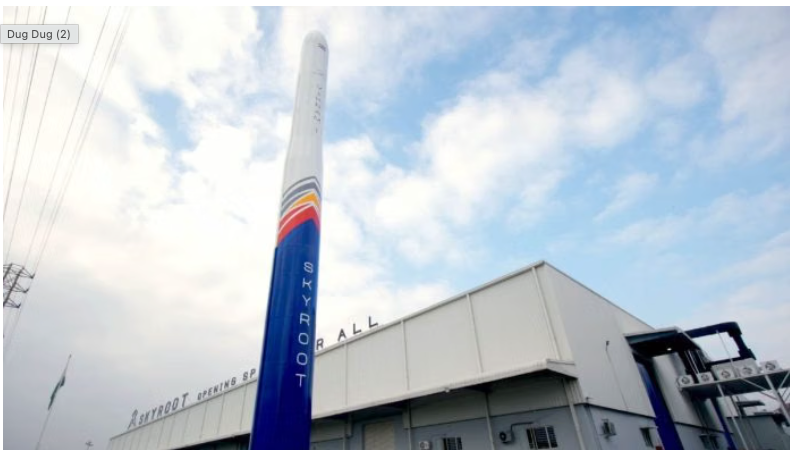
Vikram-1 is a small-satellite launch vehicle standing approximately 22 metres tall. It is designed to carry payloads of up to 350 kilograms into low Earth orbit.
The four-stage vehicle consists of three solid-fuel stages and a liquid-fuel orbital adjustment module. Its upper stage is powered by a 3D-printed liquid engine and is designed to support precise orbital deployment. The rocket also incorporates carbon-composite structures, avionics and thermal-protection technologies developed by Skyroot.
The Vikram launch-vehicle series is named after Vikram Sarabhai, the scientist widely regarded as the father of India’s space programme.
Skyroot is positioning Vikram-1 as a dedicated and rideshare launcher for small satellites requiring customised orbital deployment. The company argues that such missions can provide customers with greater control over launch timing and orbital destination than travelling as secondary payloads on larger rockets.
Payloads and Experiments
The mission carried multiple customer payloads and in-orbit experiments from Indian and international organisations.
ISRO has officially confirmed that two satellites, SCOPE and Grahaa, were successfully placed into low Earth orbit. The remaining payloads were carried on the upper stage for in-orbit experiments.
Before launch, the announced mission manifest included:
Skyroot’s SCOPE satellite
Grahaa Space’s SOLARAS S3 satellite
A technology demonstration from German space company DCUBED
Embrace, a robotic arm experiment developed by Cosmoserve Space for orbital-debris capture
The announced manifest also included symbolic payloads: a floral-shaped artwork called Cosmic Bloom and a miniature 18-karat gold rocket honouring Indian scientific figures C.V. Raman, Vikram Sarabhai and A.P.J. Abdul Kalam. These items were listed before launch, but official post-launch statements have not separately confirmed the operational status of every individual experiment.
Mission Aagaman was intended to test Vikram-1’s propulsion, avionics, telemetry, stage separation, guidance, navigation and control systems under actual flight conditions. Skyroot described the flight as the first of a planned series of development missions ahead of routine commercial operations.
From Vikram-S to Vikram-1
Skyroot Aerospace was founded in 2018 by former ISRO engineers Pawan Kumar Chandana and Naga Bharath Daka.
The company completed its first spaceflight in November 2022 with Vikram-S, a suborbital technology-demonstration rocket launched under Mission Prarambh. That flight made Skyroot the first private Indian company to launch a rocket into space from Indian soil, although Vikram-S did not enter orbit.
Vikram-1 represents a significantly more demanding technical achievement. Reaching orbit requires a rocket not only to climb above Earth’s atmosphere but also to accelerate its payload to the horizontal velocity needed to remain in orbit. The vehicle must complete a carefully timed sequence of propulsion, stage-separation and navigation operations before deploying its payloads.
India opened more of its space sector to private participation in 2020 and subsequently established a framework through IN-SPACe for private companies to access ISRO facilities and technical expertise. For Vikram-1, ISRO supported solid-motor casting and testing, liquid-engine testing, vehicle integration, trajectory analysis and launch-pad operations.
Reaction and Next Steps
Prime Minister Narendra Modi called the successful launch a defining moment in India’s space journey. He said growing private-sector participation was opening new frontiers and accelerating innovation, adding that the achievement would encourage young people to “dream bigger and innovate fearlessly.”
Skyroot said Mission Aagaman was a test flight and that it expects to conduct additional development flights before beginning routine commercial launches. The company ultimately aims to provide frequent, dedicated launch services for small satellites.
The achievement does not replace India’s longstanding government space-launch capability. Instead, it expands the country’s space ecosystem by demonstrating that an Indian private company can independently develop an orbital-class launch vehicle and successfully place satellites into orbit with institutional support from ISRO and IN-SPACe.
Sources: Indian Space Research Organisation, Prime Minister’s Office of India, Reuters, Skyroot Aerospace and Space.com.
Image courtesy: Skyroot Aerospace
SEINET is an execution focused network for operators building partnerships and growth in EU-India-UK corridor in four key clusters - Space, Deep Tech, Defense and Energy. Apply to sign up www.startupeuropeindia.net
_<->1708724263995_9Y10OskXA8FdggLg.jpeg?w=3840&q=75)